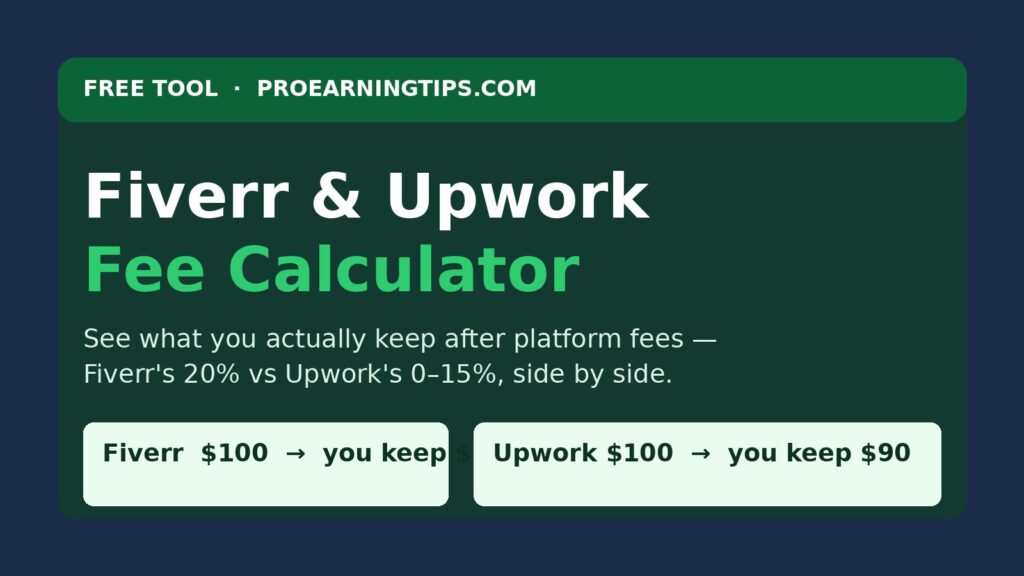
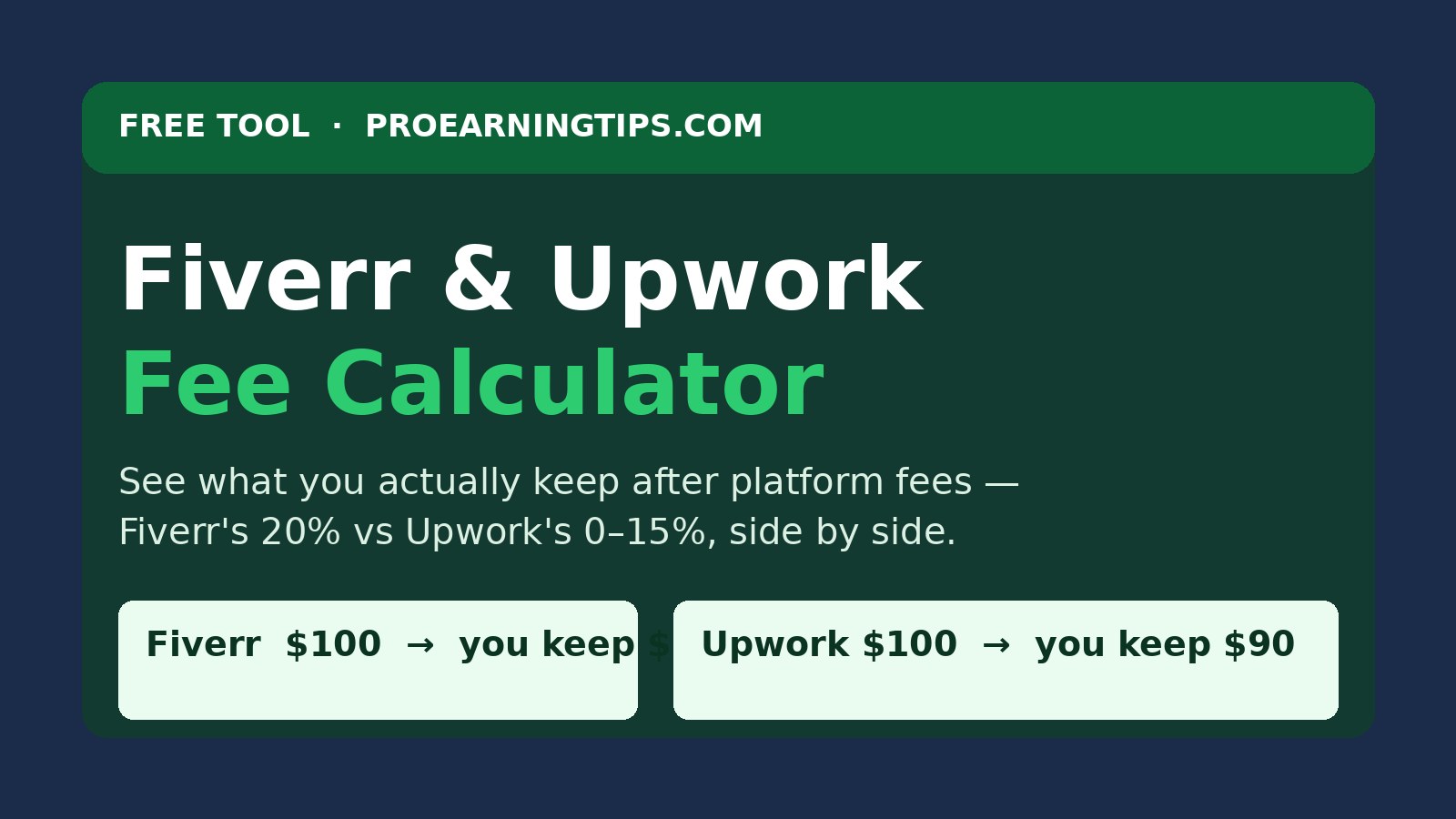
Platform fees decide your real wage long before a client does. This free Fiverr & Upwork fee calculator shows exactly what you keep from any order or contract — after Fiverr’s flat 20% seller fee and Upwork’s per-contract fee of 0–15% — and its reverse mode tells you the precise price to charge when you already know the take-home you need. Use the Fiverr & Upwork fee calculator below before you quote your next job, not after.
Having trouble with the embedded tool? Open the calculator in a new tab.
How to Use the Fiverr & Upwork Fee Calculator
Pick your direction
Know the order price? Choose “Client pays” and see what lands in your balance. Know what you want to keep? Choose the reverse mode and the calculator works backwards to the exact price you should charge.
Choose your platform
Compare Fiverr and Upwork side by side, or pick one. Fiverr’s 20% seller fee is fixed. Upwork’s fee is set per contract (0–15%), so slide it to the rate on your own contract — most freelancers see around 10%.
See the real number
You get the fee, your take-home, and — if you add your monthly order count — what platform fees quietly cost you across a whole year. That yearly figure is the one that changes pricing decisions.
The Maths Behind Your Take-Home Pay
An illustrative example: a $100 Fiverr order leaves you $80 — Fiverr keeps a flat $20. The same $100 contract on Upwork at a 10% fee leaves you $90. Run that gap across ten orders a month and the difference is $100 a month, or $1,200 a year, before withdrawal costs.
To keep $100 on Fiverr you must charge $125, because the 20% fee comes off the top. On Upwork at 10%, you would charge $111.11. These are sample inputs — not typical market rates or expected earnings.
Fees are applied once to the gross amount. Buyer-side charges on Fiverr (a 5.5% service fee, plus a $3.50 small-order fee under $200) are paid by the buyer on top of your price — they do not reduce your earnings, but they do change what your gig “costs” from the client’s side of the screen.
Fiverr take-home = price × 0.80

Upwork take-home = price × (1 − fee ÷ 100)
fee is per contract, 0–15%

Price to charge = target take-home
÷ (1 − fee ÷ 100)

Buyer pays on Fiverr = price × 1.055
+ $3.50 if the order is under $200
Intermediate calculations keep full precision; actual platform rounding may differ by a cent. Withdrawal and currency-conversion charges vary by method and are not included.
Fiverr vs Upwork Fees at a Glance
One platform keeps its fee simple and steep; the other made its fee variable — which means the only honest answer to “how much does Upwork take?” is “check your contract”. Here is the full picture, checked against both platforms’ published rates in October 2026. You can cross-check the maths with Upwork’s own Fiverr fee calculator.
| Fee | Fiverr | Upwork |
|---|---|---|
| Freelancer service fee | Flat 20% of every order | 0–15% per contract, set before you accept (most ≈10%) |
| Fee on tips & extras | Yes — same 20% | Yes — same contract rate |
| Buyer / client-side fee | 5.5% + $3.50 on orders under $200 | Marketplace fee on client plans (client pays) |
| Fee changes with volume? | No — 20% at every level | No tiers — the rate is fixed per contract, not by lifetime billings |
| You keep from $100 | $80 | $85–$100 ($90 at the common 10% rate) |
What common order sizes actually pay you
| Order / contract price | Fiverr fee (20%) | You keep on Fiverr | Upwork fee (10%) | You keep on Upwork |
|---|---|---|---|---|
| $25 | $5.00 | $20.00 | $2.50 | $22.50 |
| $50 | $10.00 | $40.00 | $5.00 | $45.00 |
| $100 | $20.00 | $80.00 | $10.00 | $90.00 |
| $250 | $50.00 | $200.00 | $25.00 | $225.00 |
| $500 | $100.00 | $400.00 | $50.00 | $450.00 |
| $1,000 | $200.00 | $800.00 | $100.00 | $900.00 |
Working out your rate from the other direction? Our Freelance Writing Rate Calculator builds a full project quote — hours, revisions and fees included — and the free Online Earning Advisor matches your skills to the platform where they earn best.
Why Every Freelancer Should Run the Fee Maths Before Quoting
Most beginners price a gig by looking at competitors, then discover the fee afterwards — which means the platform, not the freelancer, decided the real wage. A 20% fee does not sound dramatic on one $50 order. On $2,000 of monthly orders it is $400 a month, every month: $4,800 a year handed over before withdrawal charges. That is exactly why this Fiverr fee calculator and Upwork fee calculator exist as one tool — the comparison is the decision.
Three habits separate freelancers who keep their rates from those who quietly discount themselves:
Price from the take-home backwards. Decide what the work must pay you, then gross it up with the reverse mode above. If you want to keep $80 for a piece of work, a Fiverr gig priced at $80 actually pays you $64 — the gig needs to be $100.
Count the invisible hours too. Fees are only the first deduction; unpaid messaging, revisions and proposal-writing shrink the effective hourly rate further. Our guide to how beginners earn with freelance writing walks through the full after-fee hourly maths.
Re-check your platform mix once a quarter. Fee structures change — Upwork replaced its old tiered system with per-contract rates in 2025, and Fiverr has adjusted buyer-side charges over time. A five-minute check with this calculator before a new contract is cheaper than a year of the wrong assumption. For a broader starting point, browse the free tools hub and the beginner eBooks library.
Frequently Asked Questions About Fiverr & Upwork Fees
How much does Fiverr take from a $100 order?
Fiverr keeps 20% — $20 on a $100 order — so the seller receives $80. The same 20% applies to gig extras and tips. The buyer separately pays a 5.5% service fee plus a $3.50 small-order fee on orders under $200, which raises the buyer’s total but does not reduce the seller’s $80.
What percentage does Upwork charge freelancers in 2026?
Upwork charges a variable freelancer service fee of 0% to 15% per contract. The rate is set when the contract is created — based on factors like category and market demand — and stays fixed for that contract’s life. Most freelancers report rates around 10%, so a $100 contract typically leaves $90 before withdrawal costs.
Is the Upwork fee still tiered (20% / 10% / 5%)?
No. The old sliding scale based on lifetime billings with a client was retired; Upwork moved to per-contract variable fees in May 2025. Very old contracts may still run on legacy terms, which is why checking the fee shown on your own contract matters more than any general rule.
How do I price my gig so I keep the amount I want after fees?
Divide your target by what remains after the fee. On Fiverr: target ÷ 0.80 (to keep $100, charge $125). On Upwork at a 10% fee: target ÷ 0.90 (to keep $100, charge $111.11). The reverse mode in the calculator above does this instantly for any fee rate.
Which platform leaves me more money, Fiverr or Upwork?
On fees alone, Upwork usually leaves more: at the common 10% rate you keep $90 of $100 versus $80 on Fiverr. But fees are only one variable — Fiverr brings buyers to your gig, while Upwork usually requires proposals and Connects. Many freelancers run both and route each job to the platform where the after-fee, after-effort number is better.
Does this calculator include taxes or withdrawal fees?
No. It covers platform service fees only. Withdrawal charges depend on your payout method, and taxes depend on your country and total income — set money aside for both separately. The figures here are planning estimates to help you price work, not financial advice.
Get The 2027 Side Hustle & Digital Income Checklist
Join 1,000+ smart beginners. Download our free 15-step PDF roadmap to launch your first $500–$2,000/mo online income stream.
🔒 100% Free. No spam ever. Unsubscribe at any time with one click.