Can you really learn how to make money with Claude Code if you don’t have a computer science degree? In 2026, software development is going through one of the biggest shake-ups since the internet first went mainstream. Freelancers, creators, aspiring agency owners – they’re all turning to Anthropic’s terminal-based AI, Claude Code, to plan, build, debug and ship working software in hours, not months. From November 2025 to April 2026, searches for Claude Code specialists on Fiverr shot up 938%, while AI-assisted projects on Upwork grew 109% year over year. Freelancers doing AI work earned 34% to 44% more per hour, according to the Upwork Future Workforce Index 2026.
But that’s also where the hype gets dangerous. You’ll see reels and TikToks claiming anyone can download Claude Code, type a two-word prompt and wake up to passive income. That’s not how it works. Anthropic doesn’t run a creator fund, Claude Code doesn’t pay you directly, and no one is paying for a prompt. The money comes from real businesses – founders and local companies with painful software problems they can’t fix on their own. They’ll happily pay someone who can deliver something that works, is secure, and is tested on time.
⚡ Quick Verdict: How Beginners Earn Money with Claude Code in 2026
Claude Code is a self-driving command-line developer that looks through your files, writes production code, runs builds and fixes errors – all inside your terminal. You make money by turning that speed into something a client can actually use: internal tools for small businesses ($300-$1,200), quick script fixes ($25-$150/hr), code rescue audits ($450-$1,200), or small SaaS calculators ($9-$19/month).
Earning Curve, Honestly: A beginner learning the CLI can realistically expect $50 to $300 in the first month from small starter gigs, then $800 to $2,500 a month by month three as reviews build up. Power users running agencies or multiple retainers report $4,000 to $12,000+ a month, according to verified data in the ProvenStartups Index.

There’s another trend driving Claude Code in late 2026: code-animated reels and short-form videos (made with code-video tools like Remotion) are exploding on TikTok, Instagram and YouTube Shorts. Developers are filming their terminal builds, adding punchy syntax highlighting, and sharing their ‘build in public’ journey. That content is pulling in millions of organic views, bringing in client enquiries and SaaS beta testers without spending anything on ads.
What Exactly Is Claude Code? (Entity Definition & Architecture)
If you want to understand why clients pay for Claude Code, you first need to understand what it actually is – and how it’s different from a normal chatbot like ChatGPT or Claude.ai. In simple terms, Claude Code is a terminal-based AI coding tool built by Anthropic. Unlike a web chatbot that just prints text in a browser, Claude Code works directly in your computer’s terminal (macOS Terminal, Linux, or Windows PowerShell via WSL).
When you start Claude Code in a project by typing claude, it gets structured, permission-based access to your files, version control and development tools. That means it can:
- Read and understand your folders. Claude Code reads lots of files at once and works out how functions in
src/api/auth.tsconnect to models inprisma/schema.prisma. - Edit files. Instead of you copying and pasting code, Claude Code changes files on disk, writes the diffs and saves them directly.
- Run shell commands, linters and compilers. It runs
npm run build,pytestorcargo check, looks at the errors, and keeps fixing its own code until the build passes. - Manage Git. It writes clear commits, formats pull request summaries, and handles branching as per the project guidelines.
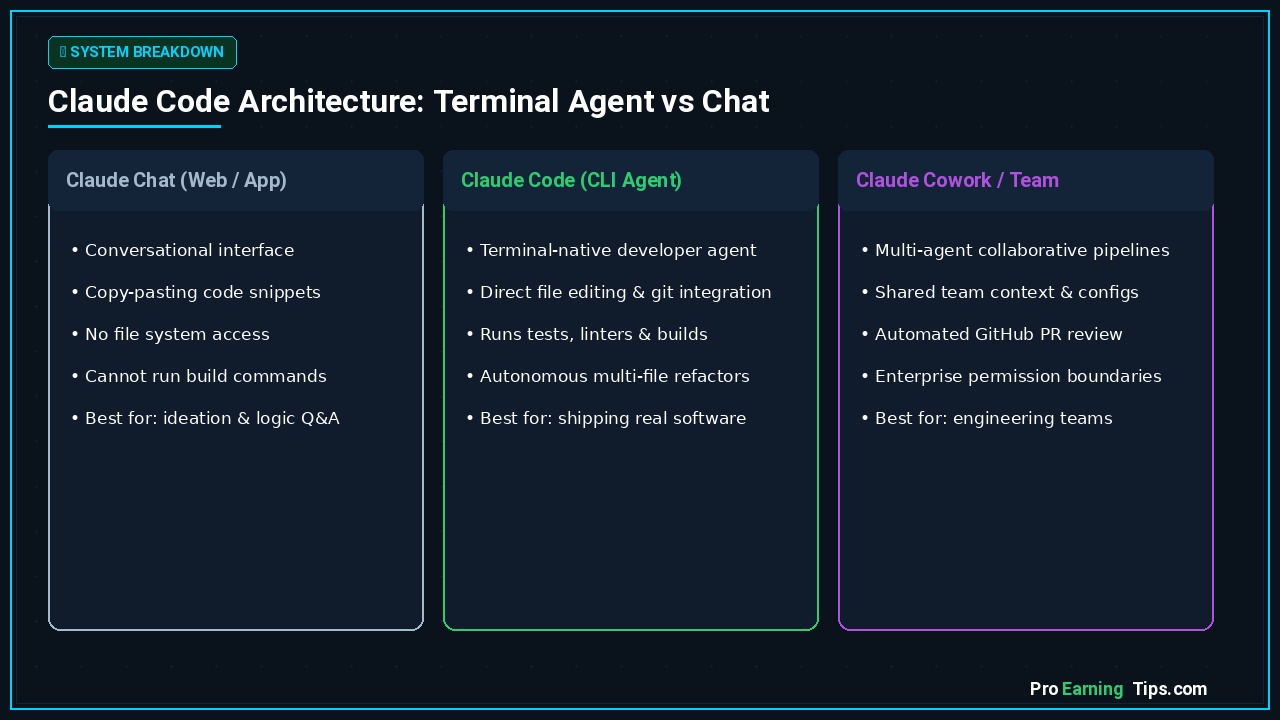
Claude Chat vs. Claude Code vs. Claude Cowork: What Is the Difference?
One of the most frequent points of confusion among beginners researching how to make money with Claude Code is telling Anthropic’s different tools apart. Here’s what you need to know:
| Feature / Capability | Claude Chat (Web / Mobile) | Claude Code (CLI Agent) | Claude Cowork / Team |
|---|---|---|---|
| Primary Interface | Browser window or mobile app | Local OS Terminal (Bash/Zsh) | Integrated enterprise workspace |
| File System Access | None (manual file uploads only) | Direct read/write access to project tree | Shared cloud repo integration |
| Terminal Execution | Cannot run bash or build commands | Runs tests, compilers, and linters live | Automated CI/CD action triggers |
| Multi-File Refactoring | Difficult; high hallucination risk | Autonomous across 20+ repository files | Parallel multi-agent branches |
| Best Commercial Use | Brainstorming, drafting content | Shipping client software & micro-SaaS | Enterprise team collaboration |
When a client hires a developer, they’re not paying for advice. They’re paying for software that works – it compiles, it runs without errors, it respects their security rules, and it passes their tests. Claude Code gives a solo freelancer the output of a three-person junior dev team, so you can charge competitive fixed prices and finish the work much quicker.
Claude Code Pricing Explained: What It Costs in 2026 (Pro vs. Max vs. API)
One of the biggest financial decisions you’ll make when learning how to make money with Claude Code is which plan to choose. Unlike a lot of developer tools, there’s no free version of Claude Code. You can download the npm package (npm install -g @anthropic-ai/claude-code) for free, but it won’t work without an active Anthropic account.
Here’s what pricing looks like in 2026, based on Anthropic’s official docs and live benchmarks:
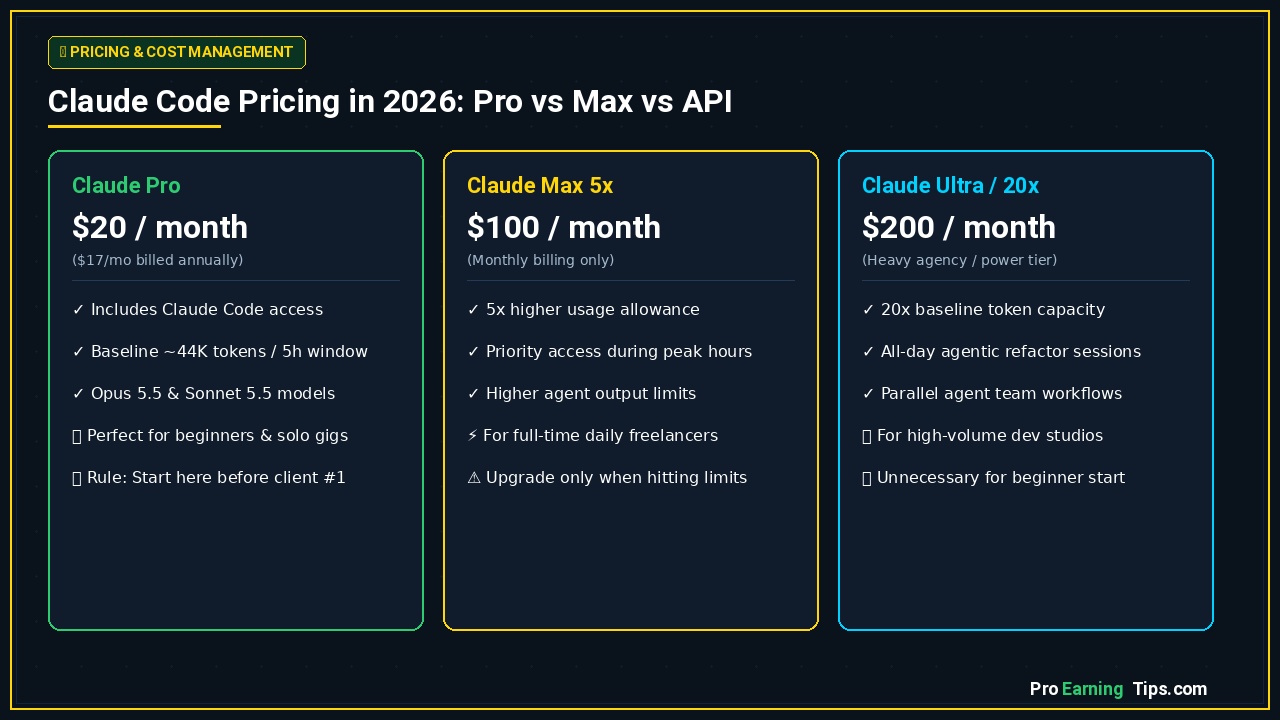
1. The Claude Pro Plan: $20 / Month (The Golden Beginner Starting Point)
The Pro plan costs $20 a month ($17/month if billed annually at $200). A lot of people think Claude Code is only on expensive enterprise plans. It’s not – full CLI access is included in Pro. You get a baseline allowance of around 44,000 tokens per 5 hours, across Claude 3.5 Sonnet and Opus.
The Golden Rule for Beginners: Don’t buy an expensive plan before you’ve earned your first dollar. Pro at $20/month is more than enough to learn the commands, build your first 10 automation scripts, create small portfolio MVPs and complete your first couple of client gigs. If you stay organised and don’t run huge directory scans, you’ll rarely hit the 5-hour limit.
2. Claude Max 5x Plan: $100 / Month (For Full-Time Independent Freelancers)
Max 5x is $100 a month, billed monthly. It gives you 5x the usage of Pro (around 88,000 tokens per 5 hours), plus priority routing during busy hours and higher weekly caps. At about $3.30 a day, it’s the sweet spot for full-time contractors who spend 6-8 hours a day building software, refactoring old code and managing client retainers. Only upgrade when you’re hitting Pro limits more than twice a week and you’ve already got paying clients covering your costs.
3. Claude Ultra (Max 20x): $200 / Month (For Multi-Agent Dev Studios)
Claude Ultra is $200 a month (formerly Max 20x). It gives you 20x Pro usage, so you won’t get interrupted mid-session – ideal for power users running parallel agents, automated builds via GitHub Actions, and large enterprise refactors. For beginners, it’s not needed and just wastes money.
4. The Anthropic API (Pay-As-You-Go Option)
You can also use Claude Code with an Anthropic Console API key instead of a monthly subscription. In this case, you only pay for the tokens you use. According to Anthropic’s own data, a typical developer spends around $6 a day on API credits, with 90% spending less than $12 a day. If you only code at weekends, the API might cost less than $15 a month. But if you’re running deep refactors and multi-file searches, token use can climb fast – so a flat $20 Pro or $100 Max plan is usually more predictable.
💡 Tax Tip for Self-Employed Creators
Your Claude Pro or Max subscription, domain purchases, and hosting accounts (Vercel, Supabase) are legitimate business expenses. You can deduct 100% of these software costs from your freelance income on Schedule C to reduce your self-employment and income tax. Use our free Freelance Tax Calculator to work out your exact 1099 deductions and quarterly IRS payments.
The 8 Proven Ways to Make Money with Claude Code in 2026
To Make Money with Claude Code you need to think of yourself as an Infrastructure Solutions Provider not a Prompt Engineer. Your client won’t care if you took 40 hours typing code in Vim or 45 minutes telling Claude Code what to do in your terminal. All they will care about is that you’re providing a working solution, delivered on time. Are you solving their money issues?
Based on verified freelance marketplaces, indie hacker benchmarks and verified retainers, here are the 8 highest earning ways to Make Money with Claude Code. These are listed in order of fastest to earn.
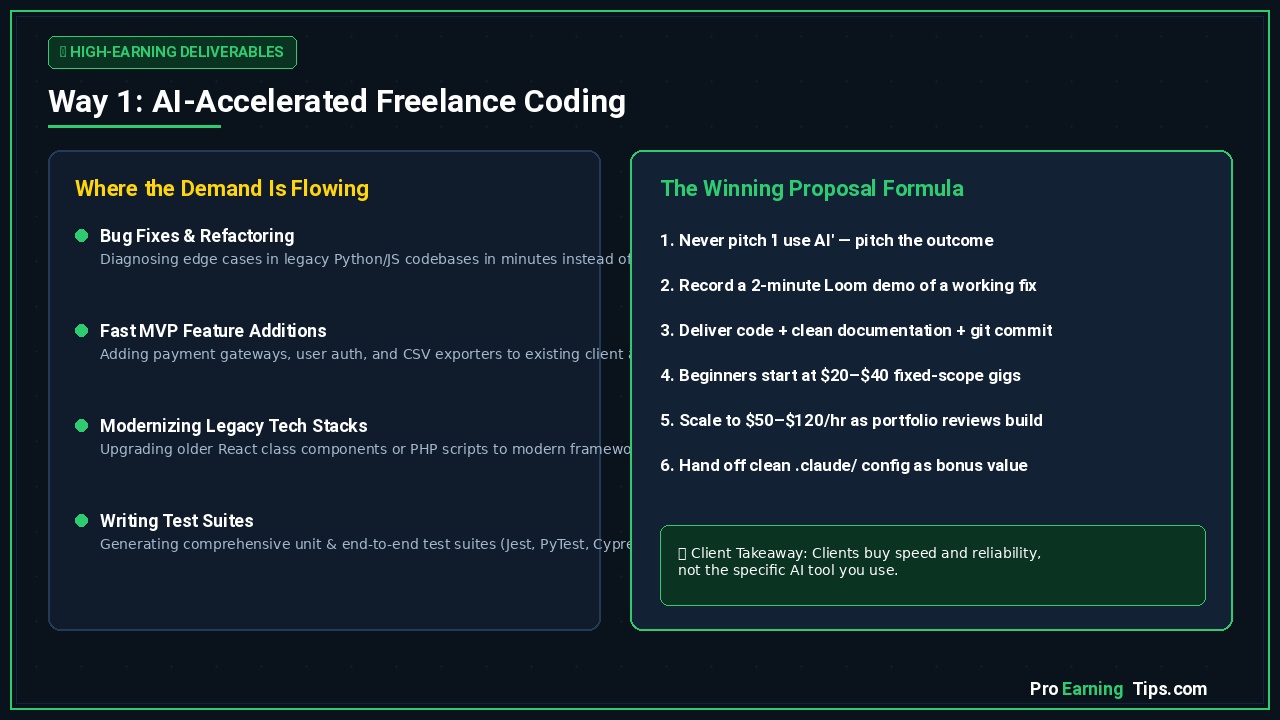
Model 1: AI-Accelerated Freelance Coding (Upwork, Fiverr & Direct B2B)
There is no faster way to earn your first dollar with Claude Code than to offer fast niche development on sites like Upwork, Fiverr, Contra & Freelancer.com. Successful freelancers will avoid bidding on large scale 6 month projects that require 10 senior architects. Instead they will bid on niche, fast coding projects that non-AI coders just can’t do due to them taking too long to quote.
The 4 Most Profitable Freelance Micro-Services
- Specific Bug Fixes & Syntax Errors – Your startup founder has a specific bug to fix. Their app has a broken stripe webhook, the database keeps timing out or they have an unhandled JSON parse error in production. You clone their repo, open Claude Code and tell it to “Reproduce the bug described in issue #42, trace where the payload drops in src/webhooks/stripe.ts, and write a failing unit test before fixing the root cause.” This will usually take engineers 3 hours to work out. With Claude Code it only takes 15 minutes.
- Fast MVP Features – Small companies often have single feature requests. Maybe they want a CSV export button, social login using Google OAuth, PDF invoice generator or dark mode. Claude Code will scan the codebase and identify any components that can be used. It will create the new feature perfectly matching their styling.
- Legacy Code Upgrade – There are thousands of established businesses still using legacy code (react class components from 2019, AngularJS or python 2 scripts). Claude Code will upgrade their components to modern typescript functional components or Python 3.12. It will keep the exact same business logic.
- Automated Test Suites – Many solo founders launch MVPs without any unit or integration tests. Investors or enterprise clients will want them to have some automated tests. You can tell Claude Code to “Inspect src/services/ and write Jest unit tests covering all edge cases, aiming for 85%+ branch coverage.” Providing a full test suite will give you an extremely high value service and your client will happily pay premium fixed fees.
📌 Documented Project Case: Google Sheets to Slack Notification Bot
Project Overview: A marketing agency needed a custom slack bot to automatically notify their account managers whenever a new enterprise lead submits a form. This would be logged in Google Sheets. Manually: Creating the google oauth tokens, webhook listener, formatting the block kit JSON cards and handling retry logic would take 8-10 hours. Claude Code: By instructing Claude Code in the repo, the webhook listener and unit tests were created in 2-3 hours. Money: This was quoted at a competitive fixed price of $500-$800. This effectively means you earned over $200 per hour and delivered 3 days early.
Realistic Earnings & The Winning Proposal Formula
For your first 30 days you want to get 5 star reviews. Bid on low fixed price jobs ($25-$60). Deliver in under 3 hours. Run full linters and deliver clean, well commented code. Provide a 2 minute Loom video showing the fix.
Once you have 5 verified positive reviews, you can move onto hourly rates. Experienced developers with high domain knowledge and Claude Code specific workflows often charge $90-$150+ per hour on Upwork. This is because your net speed means clients can halve their project timelines.

Model 2: Selling Pre-Built Automation Scripts & Niche Scrapers
If you enjoy creating standalone digital products, then creating automated scripts or niche tools is a great way to earn money. There are thousands of non-technical marketers, real estate investors, e-commerce managers or agency owners that need automated workflows but don’t know how to code in Python or Node.js.
Top Distribution Marketplaces for Automation Scripts
- Gumroad / Lemon Squeezy – Create simple automation scripts. Example: Automated Google Drive invoice renamer, Customer review sentiment downloader to Notion or Price tracking utility for Amazon to Shopify. Price scripts at $19-$49. Include a simple 5 minute video showing how to run the script with one click.
- Apify Store – This is a niche marketplace for web scraping and automation bots (Actors). Use Claude Code to create clean, reliable scrapers for e-commerce sites, directory sites or real estate listings. When published to the Apify Store you will earn recurring income based on how much computing power your subscribers use when they run the scraper.
- CodeCanyon / Envato Market – Create niche utility plugins for WordPress, Shopify or WooCommerce. Even simple plugins like an automated broken image replacer or XML sitemap cleaner often earn hundreds of sales at $24-$49 per license.
- GitHub Sponsors – Create an open source CLI tool or developer tool. Offer advanced features such as multi-tenancy authentication or cloud sync for a private sponsor price of $10-$29 per month.
Many competitors will often show you how they made $10k in their first 90 days. In reality unless you have a huge social media following, you will earn very little from creating digital scripts. Usually between $100-$400 per month from your first 3-6 products. However they are a brilliant passive income source as there is no marginal cost to provide them once built.

Model 3: Building Profitable Micro-SaaS (Weekend Builds & Recurring MRR)
Every modern digital entrepreneur dreams about making Monthly Recurring Revenue (MRR). Before Claude Code, creating a basic SaaS product would take months of full stack development. You would have to set up database migrations, authentication, UI components and Stripe billing. Now with Claude Code, anyone with an understanding of what they want can create a full micro SaaS in a weekend.
The 4-Step Claude Code Micro-SaaS Blueprint
- Find a Niche Problem – Don’t try to create the next Slack or Salesforce. Search forums, Reddit (r/SaaS, r/smallbusiness) and Capterra reviews. Look for 1 star reviews about how clunky the current tools are. Look for specific tools. Maybe a PDF invoice generator for landscapers, calorie calculator for personal trainers or compliance checker for short-term rental hosts.
- Create
SPEC.md– Before writing any code, create a SPEC.md file. Write out what your target user is, what data you will need (Users, Invoices, Subscriptions), what endpoints you will need and what Stripe pricing tiers you want. Claude Code works incredibly well with SPEC.md files. - Build with Claude Code – Open Claude Code in your project folder. Tell it to “Read SPEC.md. Initialize a Next.js 15 project with Tailwind CSS, Prisma ORM, Supabase PostgreSQL database, and NextAuth. Implement the database schema and verify with prisma db push.” Claude Code will build the project, connect to the database, run tests in the terminal and style the dashboard iteratively.
- Deploy with Vercel – Push to GitHub and connect to Vercel. This is free and instantly deploys your app globally. In addition to traditional SEO and social marketing, modern builders will deploy their apps to niche marketplaces like Whop. This has over 1 million active software buyers looking for community tools.
Realistic Unit Economics of a Micro-SaaS
Let’s look at realistic numbers.
| Financial Metric | Conservative Target | Explanation & Breakdown |
|---|---|---|
| Subscriber Count | 100 paying customers | Realistic within 3–6 months of targeted niche outreach |
| Monthly Price | $9 / month | Low friction for small business utility tools |
| Gross Revenue (MRR) | $900 / month | $10,800 annualized recurring run rate |
| Operating Infrastructure | -$101 / month | Supabase Pro ($25) + Vercel ($20) + Stripe fees (~$56) |
| Net Monthly Profit | ~$799 / month | 88.7% net profit margin on recurring autopilot |
If your first tool only gets 15 customers, this isn’t a failure! This is a software asset that will pay for your groceries each month. You’ve also learnt how to deploy a full product. As Claude Code reduced your build time by 300hrs to 20hrs, you can afford to try 3-4 micro ideas until one achieves viral traction.
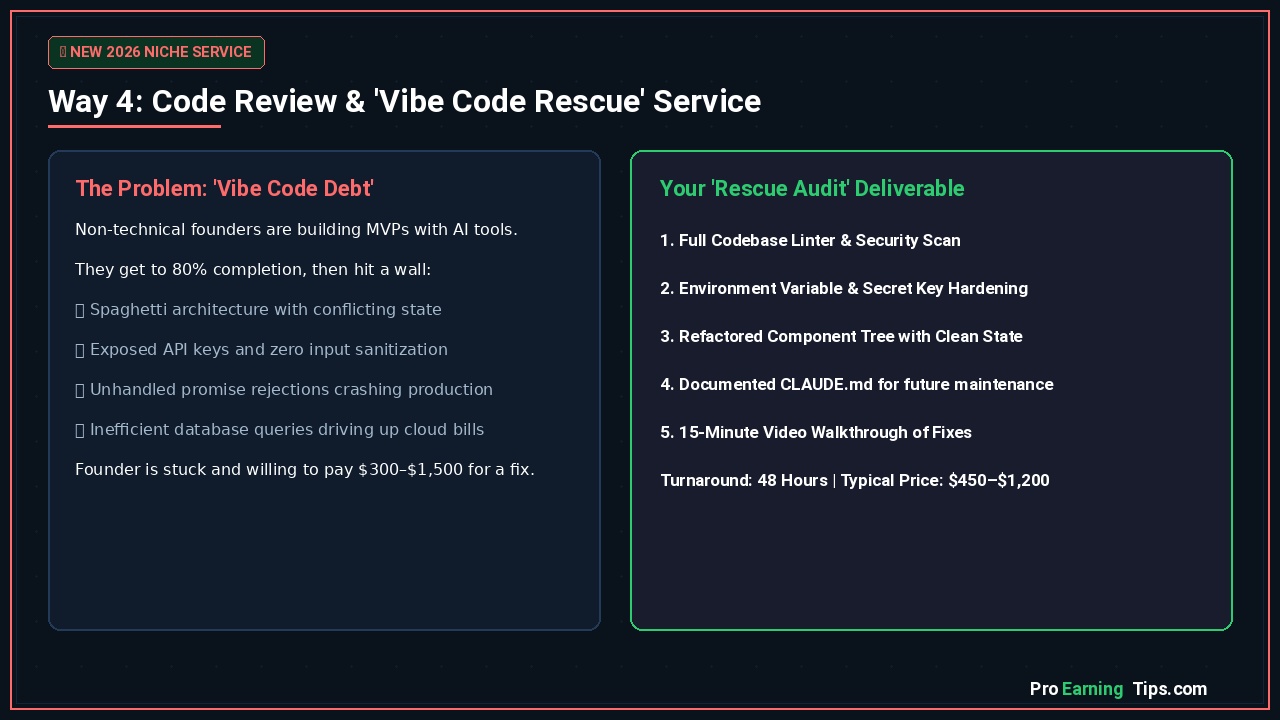
Model 4: Code Review, Speed Linting & “Vibe Code Rescue” Service
One of the newest and highest earning freelance niches in 2026 is called ‘Vibe Code Rescue’ by veterans. Tens of thousands of non-technical founders, marketers and startup dreamers have used AI visual builders (v0, Cursor, Replit Agent or Lovable) to create early prototypes. They get super excited and build 80% of their project. Then hit a wall of technical debt.
The Hidden Nightmare of Vibe-Coded Prototypes
Visual AI tools often add extra code without knowing the overall boundaries of the app. This leads to chaotic spaghetti code. Common issues include:
- Hardcoded API Keys & Secrets – Environment variables are committed to the client side. This exposes their stripe keys and openai tokens.
- Multiple React States – Multiple react states causing infinite loops.
- N+1 Queries – Endpoints making 500 SQL calls to load a table. This causes huge cloud bills.
- No Input Sanitisation – Inputs crashing their database when people type emojis, quotes or random characters.
The non-technical founder is now panicking and frustrated. This is where you come in with a ‘48 Hour Code Rescue Audit’. Clone their repo and open Claude Code. Run the following:
- Security Audit – Run secret scanners to find all the credentials and lock them away in
.envfiles. - Refactor – Remove any duplicated utility functions, normalise databases and remove any recursion.
- Ensure Build & Lint Runs – Ensure there are no errors or warnings when running
npm run buildandnpm run lint. - Provide
CLAUDE.md– Provide a clean CLAUDE.md file so they can carry on building in the future.
📌 Documented Benchmark: Django Application Speed Optimization
Case Study: A web dev agency did a full performance audit on a slow django app. Dashboard pages were taking 3.2 seconds to load. Claude Code analysed the ORM queries and found 14 N+1 query issues. This was refactored in under 3 hours. Pages now load in 200ms! The client paid a fixed price of $750 for this (Independent benchmarks). This shows clients are happy to pay for massive speed improvements to ensure they retain customers.
You can package this as a fixed price service. Charge between $450-$1200. This will take 2-3 hours in the terminal using Claude Code. You’ll make insane margins and solve their crisis!
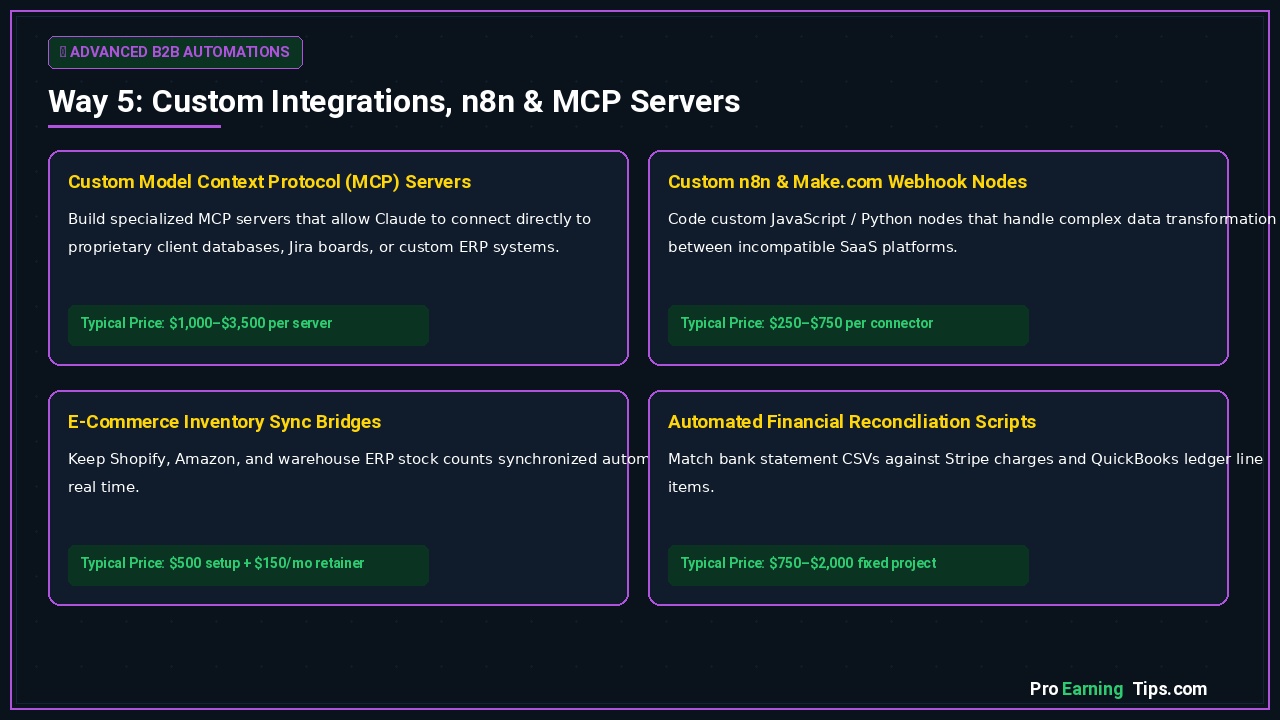
Model 5: Custom Integrations, n8n/Make Webhooks & Model Context Protocol (MCP) Servers
Every modern B2B environment contains dozens of siloed software products. For example most marketing agencies work with HubSpot as their CRM, Stripe for payments, Asana to manage their projects, and QuickBooks for accounting. And the most valuable technical skill you can offer is building custom API integrations to connect these different platforms into one automated data pipeline.
The Goldmine of Model Context Protocol (MCP) Servers
Back in late 2024, Anthropic published the Model Context Protocol (MCP), an open standard that lets AI models like Claude connect securely to external data sources, business tools, and internal databases. By 2026, building custom MCP servers has become one of the best paid enterprise consulting skills.
Companies often want Claude Code or their internal Claude setup to query their own PostgreSQL databases, pull customer tickets from Zendesk, or trigger GitHub release workflows. And you can use Claude Code to create a compliant TypeScript or Python MCP server in an afternoon:
- Define Data Schemas and Tools: Tell Claude Code:
"Build an MCP server following Anthropic's official SDK specifications that exposes read-only endpoints to our warehouse inventory database with strict role-based access control." - Implement Authentication and Rate-Limiting: Claude Code is able to handle token authorization headers, error sanitization, and structured JSON-RPC communication protocols.
- Deliver Enterprise Documentation: Package the server with complete setup guides, Docker deployment scripts, and automated unit tests.
📌 Documented Case: Real Estate MLS to CRM Automation Pipeline
The Workflow: A regional commercial brokerage needed automated data synchronization between multiple MLS property listing feeds, their HubSpot CRM, and automated social announcement channels. The Delivery: Using Claude Code to write custom n8n data transformation scripts and webhook endpoints, the developer completed the entire multi-platform sync in approximately 10 hours of active build time. Financial Return: The engagement was billed at a fixed enterprise price of $3,000 (single-source reported case via wealthfromai), illustrating the immense value businesses place on eliminating manual data entry across disconnected enterprise systems.
An individual custom MCP server engagement commands between $1,000 and $3,500 for two to three days of implementation. In addition, businesses gladly pay $250 to $750 for custom webhook transformers in n8n or Make.com that format raw API payloads between unsupported legacy tools.
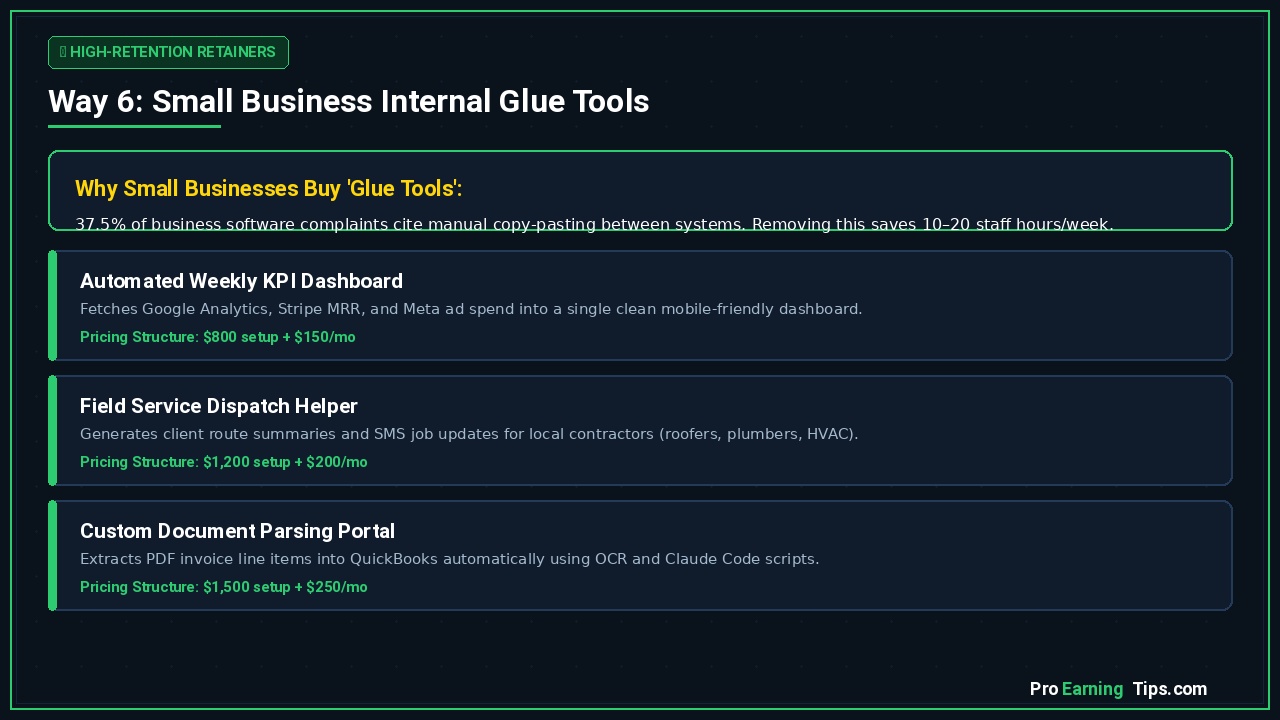
Model 6: AI Automation Agency (AAA) for Small Business Internal “Glue Tools”
An exhaustive review of small business software reviews on Capterra and G2 found that 37.5% of operational complaints cite manual “glue work” — the exhausting process of employees copying customer details from web forms into spreadsheets, retyping invoice numbers into accounting systems, and chasing overdue payment reminders by hand. This administrative friction wastes 10 to 20 hours of expensive staff time every single week.
An AI Automation Agency (AAA) does not sell generic chatbots. Instead it builds lightweight, bespoke internal web tools that eliminate manual glue work for local service businesses — such as medical clinics, HVAC contractors, law firms, logistics brokers, and accounting practices. Similar to the service packaging frameworks we detailed in our guide on how to make money with Meta Muse, Claude Code enables solo operators to deliver robust software solutions that solve real business problems without massive engineering overhead.
3 High-Demand Internal Tools You Can Build This Week
- Automated Weekly Executive Dashboard: A single-page, password-protected web portal that pulls data from Stripe (daily revenue), Google Analytics (visitor counts), and Meta Ads (ad spend). Business owners check it on their smartphone every morning instead of logging into three separate complex analytics suites.
- Contractor Job Dispatcher & SMS Notifier: A lightweight dispatch tool where an HVAC or plumbing office manager enters a customer address and job description. The tool automatically maps the route for field technicians, sends an automated SMS notification to the homeowner with an arrival window, and creates an invoice draft in QuickBooks.
- Automated PDF Invoice & Receipt Matcher: A drag-and-drop web interface where office administrators drop batches of supplier receipt PDFs. Claude Code scripts extract vendor names, invoice numbers, tax amounts, and line items, exporting a verified CSV ready for one-click reconciliation.
The High-Retention Retainer Pricing Structure
The beauty of internal business tools is that you do not charge only once. Instead you’ll charge a setup fee and a recurring monthly maintenance fee:
- One-Time Setup & Deployment Fee: $800 to $1,500 (covers requirements gathering, Claude Code development, testing, and staff training).
- Monthly Hosting & SLA Retainer: $150 to $300 per month (covers database hosting on Supabase/Vercel, periodic API updates, bug fixes, and minor feature additions).
With just 10 active local business clients on a modest $200/month maintenance retainer, you secure $2,000 in predictable, high-margin monthly recurring revenue before taking on any new client build projects.
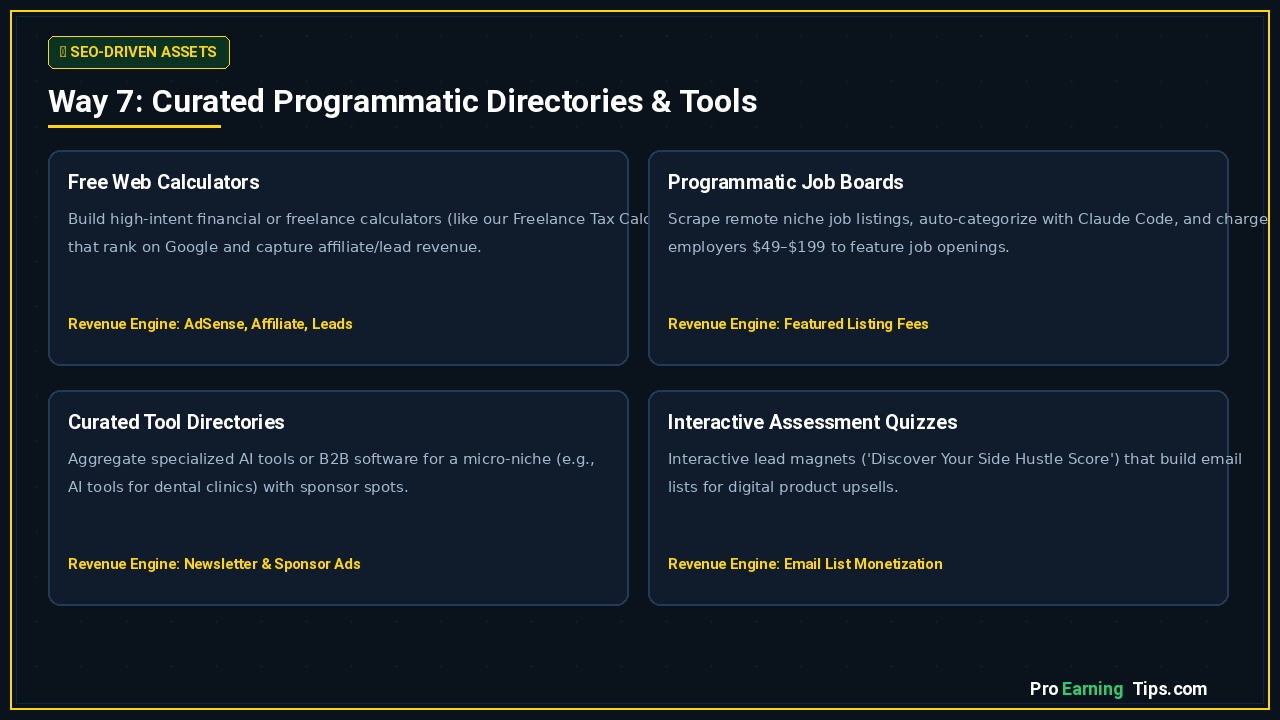
Model 7: Curated Programmatic Directories & Interactive Niche Tools
If you’d prefer building consumer facing web assets that rank well on search engines and produce advertising or affiliate revenue, programmatic directories and interactive web tools are a great long term play. Most modern search algorithms heavily favour utility first content — pages that provide immediate, functional value rather than generic 500 word blog posts.
The 3 Most Successful Tool Formats
- Interactive Financial & Operational Calculators: Notice how our own Freelance Tax Calculator provides immediate, client-side calculations for 1099 contractors. You can use Claude Code to build interactive calculators for virtually any niche: mortgage refinance calculators, Etsy seller fee estimators, freelance writing rate calculators, or commercial solar ROI estimators. These tools attract high-intent search traffic and monetize through display ads or contextual affiliate partnerships.
- Niche Programmatic Job Boards: Remote work and micro-niche hiring is growing fast. Using Claude Code, you can build a script that aggregates job listings for specific emerging roles such as AI evaluators, medical coders, or Shopify developers. Once your job board receives steady traffic, charge employers $49 to $199 per post to highlight their open positions at the top of the board.
- Curated Tool & Prompt Directories: Build directories that list specialist AI tools for particular industries — such as “Best AI Software for Real Estate Agents” or “Prompt Libraries for Architects.” You can earn money through sponsored newsletter placements, premium listing badges, and affiliate commissions on software signups.
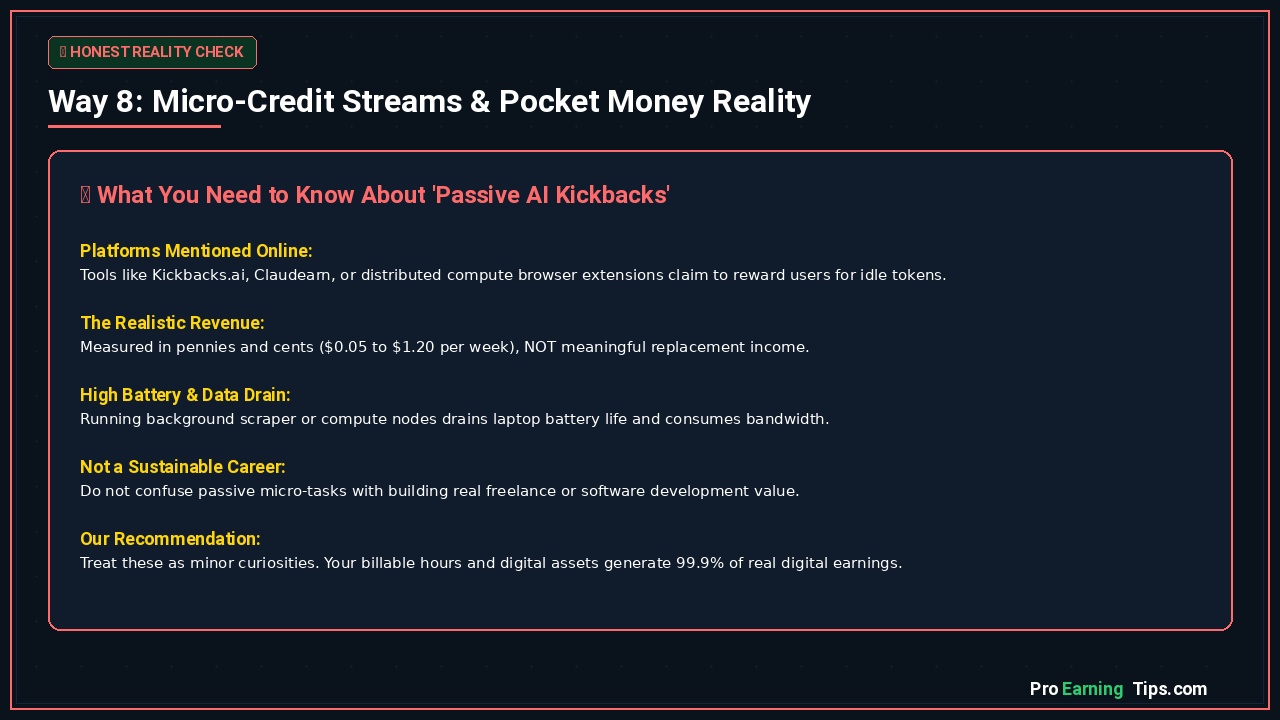
Model 8: Micro-Credit & Pocket-Money Streams (The Honest Reality of Kickbacks.ai & Claudearn)
In various online creator communities you will occasionally see posts advertising platforms like Kickbacks.ai, Claudearn, or distributed compute browser extensions that claim to pay users passive “kickbacks” for sharing unused token allowances, running background web scrapers, or validating decentralized network queries. Because ProEarningTips is an evidence based publication, we must provide an honest reality check regarding these claims.
Independent developer tests on micro-ad extensions like Kickbacks.ai, Claudearn, and AdSpin have recorded the following real-world payouts: an active developer testing these tools earned $1.34 over 20 minutes of intense coding, $4.43 over 3 hours, and an average lifetime profit of $5.85 per developer. Most of these platforms require a minimum withdrawal threshold of $10 paid out via Stripe Connect or PayPal. Whilst getting a few dollars in pocket money whilst coding may sound great, it does not constitute a viable financial strategy. Focus your energy on client deliverables and digital assets where the same 3 hours could earn you $150 to $450 in billable income.
⚠️ The Reality of “Passive AI Payout” Platforms
Earnings from decentralized micro token or scraper networks are measured in cents and pennies — typically between $0.05 and $1.50 per week. They consume huge amounts of CPU resources, drain your laptop battery and possibly put your network privacy at risk if malicious scraping payloads run through your IP address.
Editorial Verdict: Do not waste your valuable time attempting to harvest pennies from idle background extensions. Earning a real digital livelihood comes from building billable technical skills, shipping client software, and selling high-utility digital assets. Spend your time mastering Models 1 through 7 instead.
Honest Earnings Reality: Month 1 to Month 12 (Evidence-Based Benchmarks)
If you search online for how to make money with Claude Code, you’ll find bloggers making wild claims about how creators earn $10k within their first 90 days, or $12k a month with absolutely no coding experience. As this is a data backed finance blog, we’re going to tell you the truth about what you can really earn based on our field research. Below shows the actual earnings curve based on independent builders, freelance data and the ProvenStartups Index.

What the ProvenStartups Index Actually Tells Us
There are currently 54 independently audited businesses and solo software studios using Claude Code as their main development tool and terminal AI agents as of November 7th 2026. Of those 27 businesses who are currently disclosing their Stripe revenue figures, the median monthly revenue is $13,000 per month. This shows us something important:
- Top 10%: High-earning B2B agencies and niche vertical SaaS products generating between $24,000 and $65,000 per month. These founders typically have 2+ years of prior industry domain experience.
- Middle 50%: Solo contractors, specialized integration consultants, and micro-SaaS operators earning between $3,500 and $14,000 per month.
- Bottom 40%: Early stage builders starting out and earning between $200 – $1,800.
Below are some examples of publicly available businesses who are using Claude Code and are included in the benchmark:
- Stella (Manifesting/Mindset App): Niche app, making over $300,000+ in Monthly Recurring Revenue. Used Claude Code to help speed up front-end testing.
- Hero Analytics: Niche SaaS analytics tool. Making around $96,000 in MRR. Maintained and scaled by a small engineering team using terminal AI.
- Clarvo (AI Power Dialer): Outbound dialler tool. Has scaled to $1,000,000 ARR.
- Payout (Solo Micro-App): A focused solo developer utility that scaled from zero to $20,000 per month within 50 days of initial launch.
Note: They didn’t magically earn this money from Claude Code. All they did was identify their perfect target customer, solve their burning pain point and use a simple, high traffic marketing channel.
The 3 Realistic Earning Stages for Beginners
| Development Stage | Timeframe | Realistic Monthly Range | Core Focus & Activities |
|---|---|---|---|
| Stage 1: Learning & Foundation | Months 1 – 2 | $50 – $300 / month | Mastering terminal syntax, completing 2–3 micro-gigs ($25–$50 each), building 2 portfolio tools, covering your $20 Pro plan. |
| Stage 2: Consistent Client Flow | Months 3 – 5 | $500 – $2,000 / month | Hourly freelancing at $40–$65/hr, landing your first local business automation client ($150/mo retainer), launching a digital script store. |
| Stage 3: Scale & Retainers | Months 6 – 12 | $2,000 – $6,000+ / month | 5–8 monthly retainer clients ($1,500+ recurring baseline), premium fixed consulting audits ($800–$1,500), and micro-SaaS MRR. |
Firstly, you won’t earn any passive income during your first 60 days. You’ll be spending your first few months learning and trading your time for customer feedback. Successful builders will use Claude Code as a productivity tool.
Mandatory Limitations & Prerequisite Skills (What Nobody Tells You)
If someone is telling you you can earn thousands of dollars with Claude Code and you have no technical skills, they are lying to you. Whilst you don’t need a 4 year degree in computer science or even know how to manage memory in C++, you do need to have basic technical skills. Trying to sell software development services without understanding basic operating systems is a guaranteed way to get into disputes with clients and get negative reviews.

The 4 Essential Skills You Must Learn Before Bidding on Gigs
- Command Line Interface (CLI): You should know basic commands like
cd(change directory),ls -la(list files),mkdir(make a folder), and package managers likenpm,pnpm, or Pythonvenv. Claude Code runs from your terminal and you need to know where your files are located on your hard drive. - Git & GitHub: You should know how to clone your repo (
git clone), create a branch for your new feature (git checkout -b), stage your changes (git add .), commit them (git commit -m), and push pull requests to GitHub. All professional clients will expect you to use Git. - Syntax: You don’t need to know every array method in JavaScript or decorators in Python but you should be able to read code and understand what it does. If Claude Code hallucinates an old API parameter or tries to import a package that doesn’t exist, you need to be able to spot this in the compiler log and ask it to correct it.
- Client Management: Don’t promise your client Claude Code will build their software in 10 mins. Promise them a professional human will build it, you’ll QA it yourself and use Claude Code as your personal assistant.
What Claude Code CANNOT Do
Never make these mistakes when starting out as a freelancer:
- Claude Code Won’t Pay You: There is no fund for creators, no passive income and no token staking. You’ll only earn money from clients sending you money to your bank account or Stripe dashboard.
- It Can’t Guarantee Zero Bugs: Often complex edge cases such as timezones, race conditions in databases or browser specific rendering issues will need additional prompting, unit testing and human verification.
- It Can’t Sell Itself: Even if you have the best Claude Code setup, you won’t earn any money if you can’t write proposals, build your portfolio and communicate with business owners.
The 7-Day Claude Code Beginner Action Plan (Zero to First Working Prototype)
The most common mistake beginners make is falling into ‘tutorial hell’. Don’t get stuck watching YouTube tutorials and never open your terminal. Below is a step-by-step guide to help you go from zero to your First Working Prototype in 7 days.
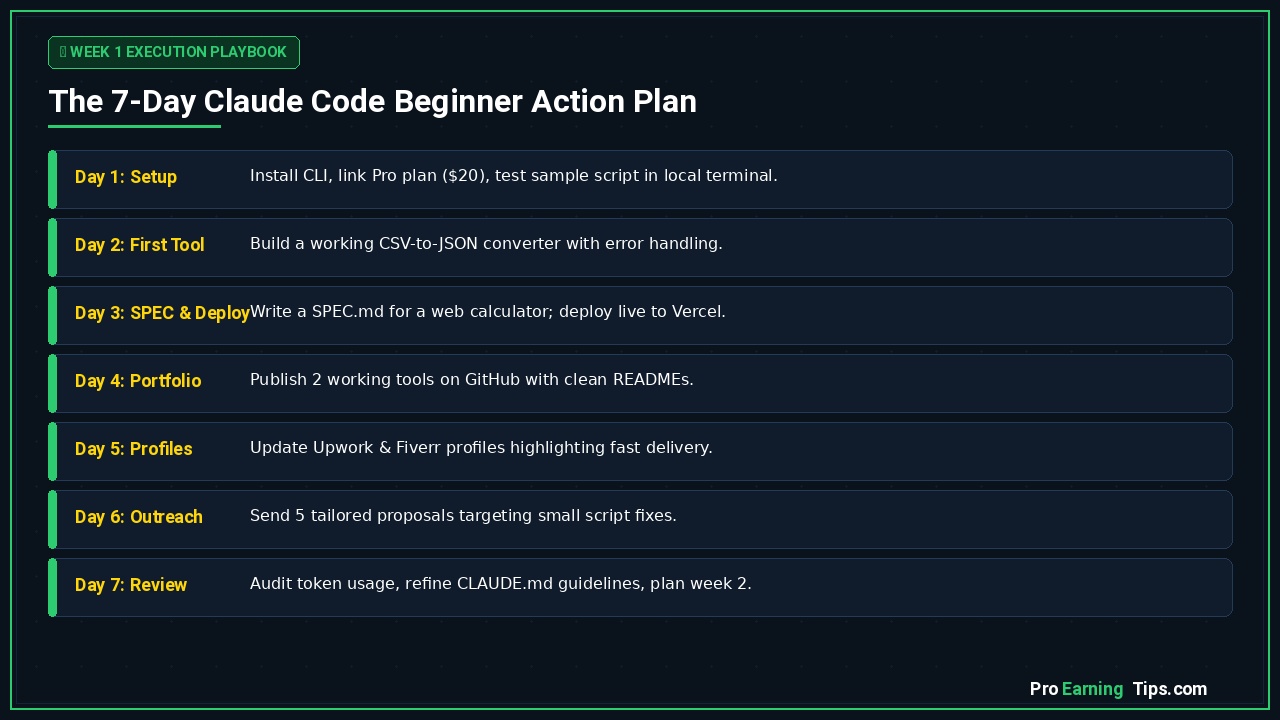
- Day 1: Set up Node.js 20+. Open your terminal and run
npm install -g @anthropic-ai/claude-code. Login to your Claude Pro account (costs $20/month). Create a new folder and typeclaude. Ask Claude Code some basic questions. - Day 2: Build your first local utility. Build a simple automation tool using Python or Node.js. Build a script that will clean up messy CSV files, check emails are valid, remove duplicates and output clean JSON. Ask Claude Code to build a tool that will parse sales.csv, highlight any missing values in red text and export a cleaned output.csv. See how Claude Code edits files and runs tests.
- Day 3: Write your
SPEC.mdand build a calculator. Write a one page SPEC for a simple calculator. Set up a new Next.js project with Tailwind CSS. Ask Claude Code to build the interactive sliders and real-time calculation logic. Push to GitHub and deploy for free to Vercel. - Day 4: Improve your GitHub profile. Make sure your 2 projects have clear
README.md’s showing live links, screenshots and simple setup instructions. Record a 2 minute Loom video explaining how your calculator works. This will be your secret weapon when applying for proposals. - Day 5: Optimise your profiles on Upwork and Fiverr. Create/update your profiles. Don’t be a generalist. Title your profile ‘Fast Frontend Bug Fixes & Next.js Script Automation Specialist’. Add your live calculator link to your portfolio section.
- Day 6: Apply for 5 proposals. Search for jobs on Upwork that have been posted in the last 2 hours. Look for jobs between $30-$100 with tags like ‘Fix broken React form’. Include a direct link to your 2 minute Loom video in your proposal. Offer to get started immediately.
- Day 7: Review your token usage. Improve your system prompts. Write down your common prompts and use them as templates. Plan your second week of client outreach.
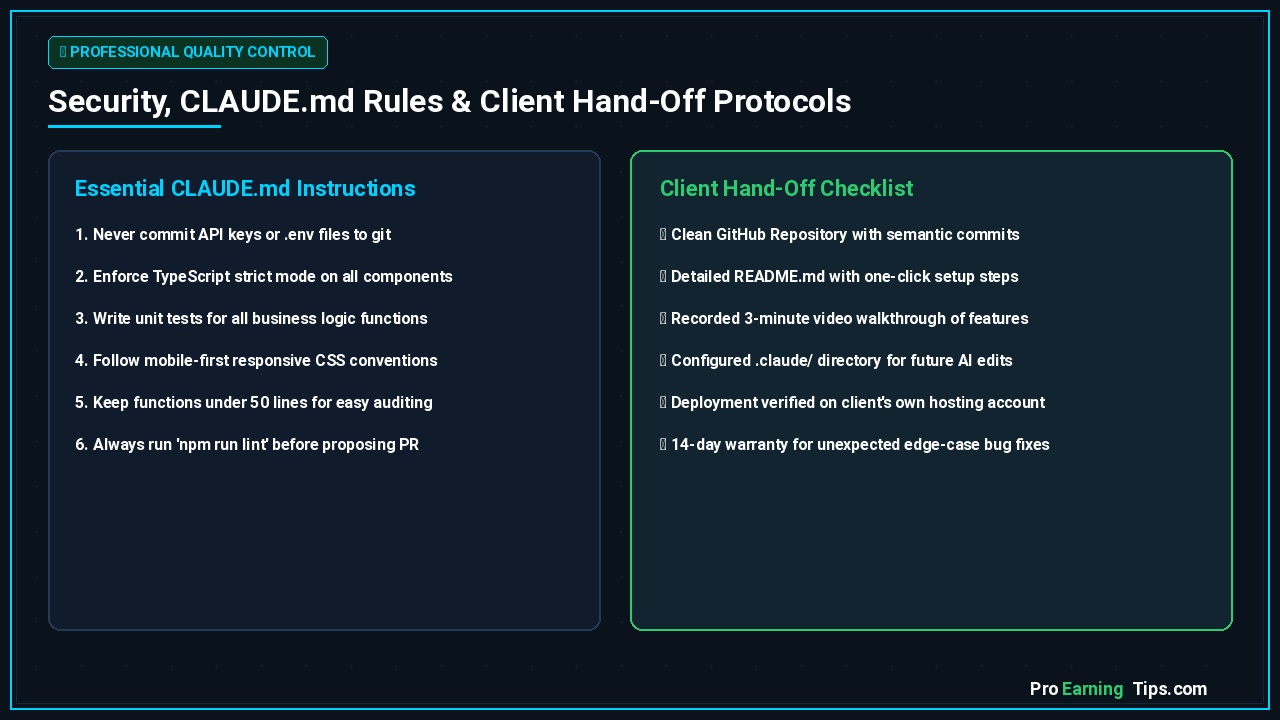
Professional Quality Control: Setting Up CLAUDE.md & Client Hand-Off Protocols
The biggest difference between hobbyists and 6 figure contractors is using a CLAUDE.md file. This file goes into the root of your project and tells Claude Code what to do.
Copy-Paste CLAUDE.md Starter Template
Below is a professional CLAUDE.md template:
# Project Architectural Guidelines & Operational Rules

## 1. Core Technology Stack
- Framework: Next.js 15 (App Router only, no Pages router)
- Language: TypeScript with strict type checking enabled
- Styling: Tailwind CSS (use mobile-first responsive utility classes)
- Database: Supabase PostgreSQL via Prisma ORM

## 2. Mandatory Security Boundaries
- NEVER hardcode secrets, passwords, or API keys in source files.
- Always load environment variables from process.env with fallback error checks.
- Sanitize and validate all client input payloads using Zod schemas.

## 3. Code Quality & Testing Rules
- Keep individual functions under 50 lines of code for modular readability.
- Write Jest unit tests for any new business logic added in src/services/.
- Ensure 'npm run build' and 'npm run lint' execute with 0 errors before committing.

## 4. Git Commit Protocol
- Use semantic commit messages: feat:, fix:, refactor:, or docs:.
- Keep commits atomic and focused on a single logical change.
When handing over your project to a client, having a set up .claude/ folder and CLAUDE.md file shows you’re an elite, forward-thinking engineer. You’re not just handing over code. You’re handing over an AI maintainable infrastructure that they can easily update for years to come.
Essential Terminal Command Cheat Sheet & Token-Saving Protocols
To maximise your earnings per hour, you need to know how to use Claude Code’s slash commands. Beginners will waste their 5 hour rolling token limit by letting Claude Code build up large amounts of conversation. Professional developers will save 4x more by keeping their terminal clean.
The 6 Terminal Slash Commands Every Paid Builder Must Know
| Command | Core Function | Commercial / Financial Benefit |
|---|---|---|
/cost | Displays token consumption and dollar spend for the active session. | Crucial for tracking API project margins and verifying you stay within Pro limits. |
/compact | Summarizes previous conversation history to clear active context memory. | Saves up to 60% of input tokens on long multi-hour client debugging sessions. |
/clear | Completely resets the context window for a brand-new feature or task. | Prevents context contamination between unrelated client bug fixes. |
/doctor | Runs diagnostic checks on your local toolchain, git, and Anthropic auth. | Instantly resolves environment errors before client deadlines are impacted. |
/review | Triggers a rigorous peer-review pass over recently modified git diffs. | Catches edge-case logic errors before submitting pull requests to the client. |
/help | Lists all active agent configuration flags, keybindings, and permissions. | Ensures you utilize latest agentic capabilities without leaving the CLI. |
3 Rules to Protect Your Five-Hour Rolling Token Allowance
- Always ignore large folders: Never let Claude Code scan through
node_modules/,.git/or build folders. Create a.claudeignorefile in your project root and include the following:
This will reduce your indexing time from 40 seconds to less than 2 seconds and save you thousands of tokens on every command.node_modules/ .next/ dist/ build/ *.png *.jpg package-lock.json - Compact after each commit: Once you have fixed a bug and committed your changes, type
/compact. This will keep the learning from your architecture but will remove hundreds of lines of compiler errors. - Be specific with your prompts: Never ask Claude Code to look at your app and improve. Always write scoped, actionable instructions: “Inspect src/components/InvoiceTable.tsx. Optimize the date sorting function so null dates always sort to the bottom. Run npm test to verify.” Being specific will give you faster, cleaner code and save you 80% of your tokens.
Copy-Paste Client Proposals: Winning High-Margin Development Contracts
When applying for jobs on freelance platforms, 90% of your competitors will use generic AI generated cover letters that say: “Dear hiring manager, I am an expert with 10 years of React experience and I can do your job perfectly.” This will get rejected instantly.
To win jobs at a premium hourly rate, your proposal needs to show you understand what they need quickly, you can do it fast and you can show them prior work. Below are 2 proven templates:
Template A: The Fixed-Price Bug Fix & Optimization Proposal
Hi [Client Name],

I read your project description regarding the [specific issue, e.g., Stripe webhook failing on recurring renewals].

This issue almost always occurs because [brief explanation, e.g., the customer.subscription.updated event payload schema changed or the endpoint lacks idempotency handling].

I specialize in fast-turnaround API debugging and production code fixes. Here is how I will resolve this for you today:
1. Clone your repo onto a dedicated feature branch.
2. Write an isolated test case that reproduces the exact webhook failure payload.
3. Patch the endpoint, verify that all existing tests pass cleanly, and run security linters.
4. Submit a clean GitHub Pull Request with a 2-minute Loom video demonstrating the fix live.

I can have this completed within [e.g., 3 to 4 hours] of contract start.

You can see my recent Next.js and API automation builds here: [Link to your Vercel demo or GitHub portfolio].

Ready to get this off your plate today. Let me know if you would like me to begin!

Best regards,
[Your Name]
Template B: The Small Business Internal Tool / Retainer Proposal
Hi [Business Owner Name],

I noticed that your team is currently spending hours every week manually [specific bottleneck, e.g., copying invoice details from email PDFs into your accounting spreadsheet].

Manual data entry not only costs 10–15 hours of staff time each week, but it also creates inevitable transcription errors that complicate month-end reconciliation.

I build custom, lightweight internal tools that automate this exact administrative friction:
- We set up a private, secure web portal where your team drops PDF receipts.
- The system automatically extracts vendor names, line items, and totals in seconds.
- It formats and reconciles the data directly into your bookkeeping software.

We handle the entire setup, database hosting, and ongoing maintenance on a flat monthly basis, so you never have to worry about broken code or server crashes.

I put together a quick 90-second video demonstrating a similar document parser we built: [Loom Video Link].

Would you be open to a quick 10-minute chat this Tuesday to see if this could save your team 40+ hours this month?

Best,
[Your Name]
By focussing purely on what they’ll gain financially, you’ll remove any concerns about cost and show you’re a trusted technology partner.
Managing Scope Creep & Setting Client Delivery Boundaries
One of the most dangerous things new AI developers will do is let clients add extra to their project without charging them more. As Claude Code makes changing code feel quick and easy, clients will often ask you to add extra features.
Set these boundaries:
- Define the scope: Within your initial proposal or Upwork milestone, specify which files/endpoints you’ll be changing. ‘This milestone includes fixing the Stripe recurring payment webhook and verifying the Jest tests. ‘Any third-party integrations will fall under phase 2.’
- Offer a 14 day free bug Fix Warranty: Everyone loves security. Give them written reassurance that you’ll fix any logic errors or syntax issues within your deliverables for 14 days after completion. This will build huge trust and justify higher rates.
- Charge for new features: If they ask for new features, never sound annoyed. Get excited and send them an invoice: “That’s a fantastic idea and would improve user onboarding significantly. I have mapped out the requirements; we can deploy that under a Phase 2 milestone for $250. Would you like me to set that up for next week?”
Frequently Asked Questions About Making Money with Claude Code
Do I need to be a professional programmer to make money with Claude Code?
No. You don’t need to be a senior developer or have a computer science degree. You do need to have some basic technical skills. You need to know how to navigate your terminal (command line), manage packages, use Git and be able to read code. Beginners will succeed by offering clear solutions to problems such as bug fixes, data scripts and calculators. Don’t try to do large scale changes.
How much can I realistically earn in the first three months?
An active beginner will earn between $50-$300 in their first month. They’ll earn between $300-$800 in their second month and $800-$2,000 in their third month. If they move into retainer work ($150-$300/month per business) or launch a profitable micro SaaS tool, they could scale to $3,000 to $6,000+ per month by Month 6 to 12.
Is Claude Code free, or what does it cost to get started?
No. Whilst the command line package is free to install using npm, you’ll need to have a paid account. The best option for beginners is to use Claude Pro ($20/month or $17/month if paid annually). This gives you full access to Claude Code and around 44,000 tokens per 5 hours. Don’t upgrade to Max ($100/month) until you have active paying clients.
Can a beginner make $100 per hour this week with Claude Code?
No. Anyone promising you can download Claude Code and charge $100/hour in your first week are lying. Your main goal in your first week will be to build up your portfolio, learn how to use Claude Code in the terminal and get your first small reviews at $20-$50 per task. High rates ($75-$150+) are earned once you’ve had months of proven deliveries, niche knowledge and 5 star ratings.
How quickly can you realistically land your first paying client?
If you follow our 7 Day Plan, you’ll spend the first 4 days learning how to use the tool, building 2 calculators and recording 2 minute Loom demos. You can realistically get your first entry level freelance job on Upwork/Fiverr in 10-14 days. This depends heavily on how targeted and personalised your proposals are.
What is the difference between Claude Chat, Claude Code, and Claude Cowork?
Claude Chat is a web chatbot for writing text, Q&A and individual lines of code. Claude Code is a CLI developer agent running in your terminal. It can read your project folders, edit files and run compilers/tests. Claude Cowork is Anthropic’s multi-agent for teams of engineers.
Conclusion: Your Next Steps to Building a Sustainable AI Income
Terminal AI agents like Claude Code aren’t taking away software development jobs. They’re making it accessible to everyone. You no longer need to spend 4 years learning complex data structures. You can act as the creative director, problem solver and QA to deliver incredible value to businesses that need to automate.
Start small. Get your $20 Pro account set up, build your first local script, deploy a clean calculator and apply for 5 clients. Be radically honest with your clients, focus on security and quality and you’ll build real sustainable income in 2026.
Explore More Proven Digital Earning Blueprints
Continue to improve your digital skills with our comprehensive guides:
- How To Make Money With Meta Muse – 11 proven done-for-you service frameworks using Meta’s autonomous AI agent.
- AI Data Annotation Jobs For Beginners – Full roadmap to earning $20+/hr analysing frontier AI training models.
- Free Freelance Tax Calculator (2026) – Calculate exactly how much tax you’ll pay on your 1099, what you can claim and when to pay the IRS.
- How To Make Money On TikTok – Proven ways to monetise as a creator with Creator Rewards and TikTok Shop.
- How To Make Money On Facebook – Monetise your short-form Reels bonuses, in-video ads and niche groups.
Get The 2027 Side Hustle & Digital Income Checklist
Join 1,000+ smart beginners. Download our free 15-step PDF roadmap to launch your first $500–$2,000/mo online income stream.
🔒 100% Free. No spam ever. Unsubscribe at any time with one click.